
Vehicle lift arm comparison
Find the right lift for your fleet
A single specification of 2 post lift is not going to suit the entire wide range of vehicles on Irish roads, considering the range from compact city cars to long-wheelbase Mercedes Sprinters. But using the product diagrams we can determine which lifts are best suited to the majority of vehicles commonly seen in your workshop.
Use arm measurements to make a suitability check
Start with the minimum and maximum arm-length measurements for the lift you are considering. Mark them out on the floor of your garage with chalk then positions your vehicle over the the marked floor and see if the manufacturer’s approved lifting points are above the marked area on the floor.
Check all four jacking points, as front and rear lifting points may be in different spots. There may also be several different recommended jacking points for various engine or gearbox specifications of the same model car.
The diagrams show arm reach, not a guarantee of vehicle compatibility. Account for arm swing, pad height and access around sills or underbody components. For longer vehicles such as a Mercedes Sprinter, also verify the lift’s rated capacity, permitted load distribution and any required adapters when making your selection.
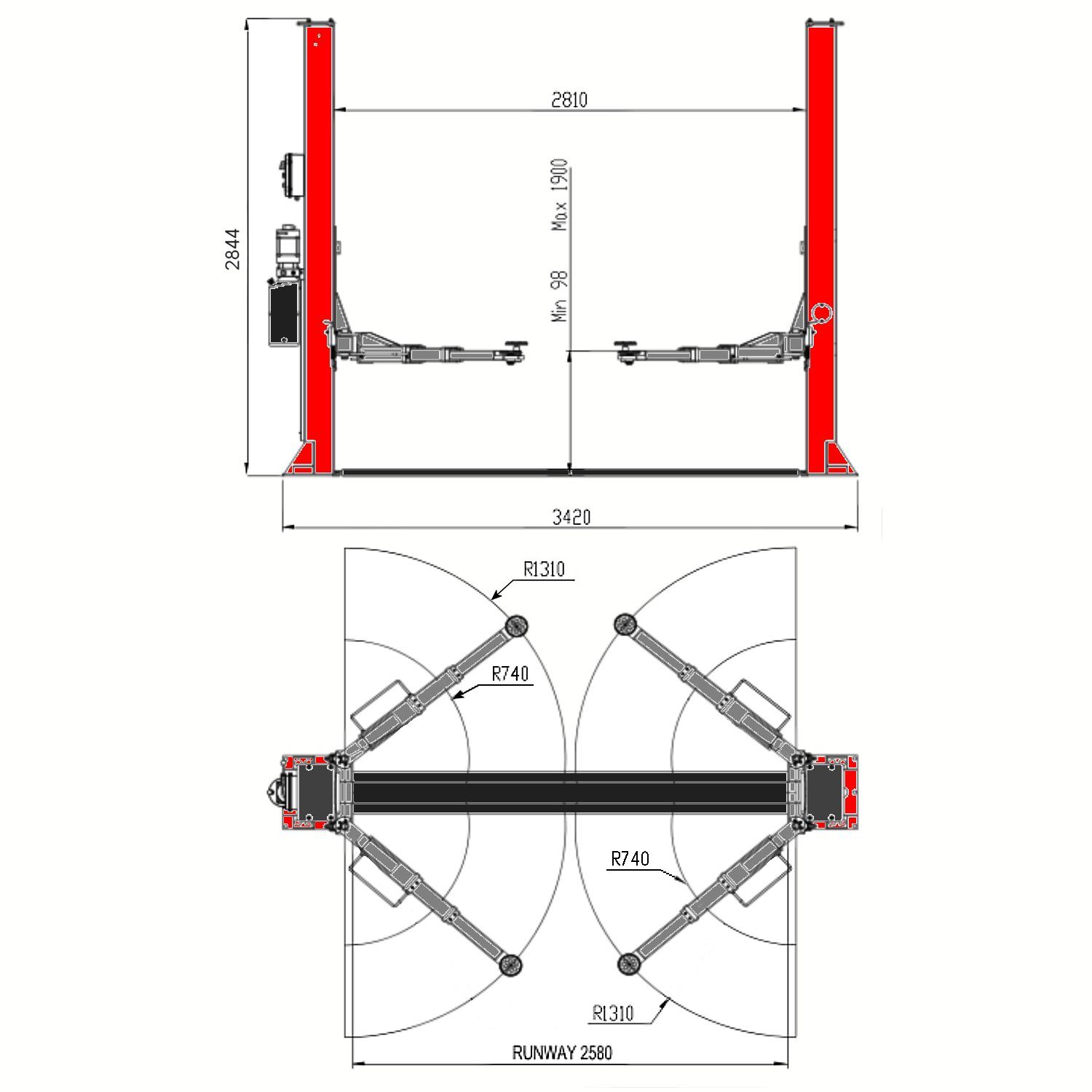
Comparing Arm Reach by Lift Model
RM4141 4000kg - 3 stage arms
All 4 arms on this lift are identical, allowing you to drive on or reverse on to the lift. Suits most cars, jeeps and light vans, for longer wheelbase vehicles consider a longer armed lift.
Minimum reach: 740mm
Maximum reach: 1310mm

RM9146 4600kg - Asymmetric Arms
Fitted with long 2 stage arms at the back and short 3 stage arms at the front. This offsets the vehicle having the engine weight closer to the posts and allowing the doors to be opened wider.
3 Stage arm
Minimum reach: 640mm, Maximum reach: 1100mm
2 Stage arm
Minimum reach: 900mm, Maximum reach: 1475mm

RM9145 4500kg - 3 Stage Asymmetric Arms
Fitted with 3 stage arms. There is a slight offset in the length of the front and rear arms.
Short arm
Minimum reach: 820mm, Maximum reach: 1500mm
Long arm
Minimum reach: 850mm, Maximum reach: 1600mm

RM5111 5000kg - 3 Stage Arms
All 4 arms on this lift are identical, allowing you to drive on or reverse on to the lift. The longer reach of these arms compared to a 4000kg lift means it will suit larger cars like jeeps up to long wheelbase vans.
Minimum reach: 860mm
Maximum reach: 1800mm
Irish Fleet Sizes and Arm Ranges to Consider
- Small city cars, such as the Fiat 500: short-reach arms with a low minimum extension.
- Superminis, such as the Toyota Yaris: short-to-medium reach with accessible sill points.
- Compact hatchbacks, such as the VW Golf: medium-reach arms for typical four-point access.
- Saloons, such as the Skoda Octavia: medium reach, checked against the longer wheelbase.
- Family crossovers, such as the Hyundai Tucson: medium-to-long reach where lifting points sit farther apart.
- Large SUVs, such as the Kia Sorento: longer reach with capacity and pad height considerations.
- Small car-derived vans, such as the Renault Kangoo: medium reach.
- Compact panel vans, such as the VW Caddy: medium-to-long reach depending on wheelbase.
- Mid-size vans, such as the Ford Transit Custom: longer reach for rear lifting-point access.
- Long-wheelbase mid-size vans, such as the VW Transporter: long reach, dependent on the exact variant.
- Double-cab pickups, such as the Ford Ranger: long reach with chassis and load distribution checked.
- Large people carriers, such as the Ford Tourneo Custom: long reach with underbody clearance confirmed.
- Short-wheelbase large vans, such as the standard Renault Master: long-reach arms, verified against point spacing.
- Medium-wheelbase large vans, such as the Ford Transit: long-to-extra-long reach.
- Long-wheelbase Mercedes-Benz Sprinter: extra-long reach, with full four-point contact confirmed.
- Extra-long-wheelbase panel vans, such as the Iveco Daily: the arms fully extended, possibly lifting on a chassis rail or suspension point.
- High-roof delivery vans: account for overhead-clearance.
- Converted or laden vans: reach and rated capacity confirmed for the actual vehicle configuration.
Questions About Lift-Arm Compatibility
Does a longer wheelbase always require longer lift arms?
Usually yes, but not always. The position of the manufacturer-approved lifting points matters more than wheelbase alone.
Is lift capacity enough to confirm a van will fit?
No. While capacity is essential, you must also confirm arm reach, pad contact, weight distribution, sill clearance and any manufacturer lifting restrictions.
Should electric vehicles be assessed differently?
Yes. Follow the manufacturer’s EV lifting instructions, protect the battery enclosure and verify any specified pad adapters and vehicle weight.
How should I use the product arm-length diagrams?
Compare each diagram’s minimum and maximum usable reach and the distance from the lift with all four approved lifting points on your vehicle.
Can one lift handle both city cars and long-wheelbase vans?
Possibly, if its arms cover both the minimum reach needed for small cars and the maximum reach needed for vans, while meeting the required capacity and clearance.
Do side steps or underbody covers affect lift choice?
Yes. They may block arm movement or pad access. Check the vehicle’s underside and whether height adapters are needed before choosing a lift.
How can I confirm suitability before buying?
Mark it out on the ground. Additionally, Experience is the best teacher. An experienced local mechanic or a specialist in your category of vehicle (German cars, Classic cars, Commercial vehicles) could advise what is working well for them.
What if my fleet includes several versions of the same van?
Check each wheelbase, body and conversion separately. Lifting-point locations and axle loads can change even when the model name stays the same.
Where can I find my vehicle’s approved lifting points?
Consult the vehicle manufacturer’s workshop information or lifting instructions for the exact model and variant. Do not assume points are identical across wheelbases or body styles.